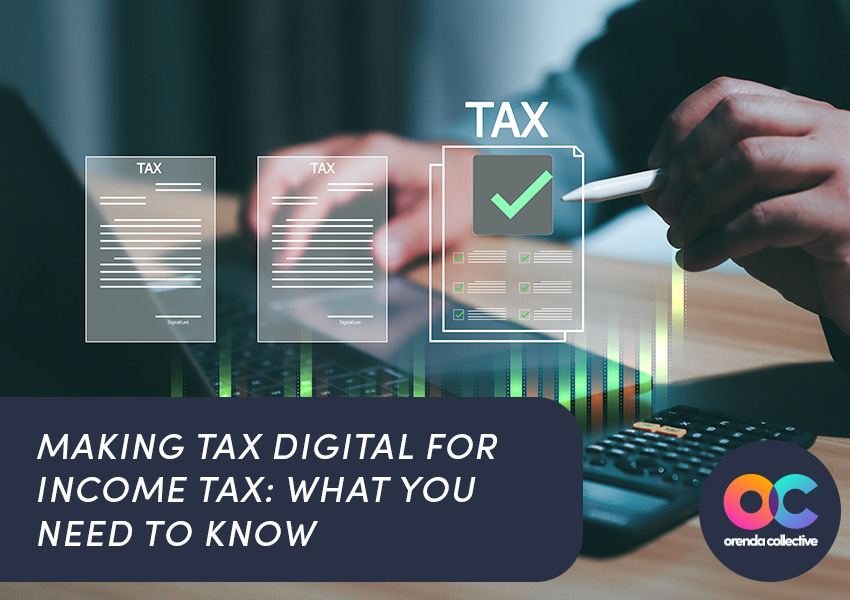
From April 2026, Making Tax Digital (MTD) for Income Tax will change the way many sole traders and landlords report their income.
Whether it applies to you depends on your gross income in the 2024/25 tax year. HMRC will look at your total self-employed income plus any rental income from that year to decide if you fall into MTD from April 2026.
Thresholds and When They Apply
- From April 2026 – If your combined gross income is over £50,000, you must follow the new rules.
- From April 2027 – The threshold reduces to £30,000.
- From April 2028 – It reduces further to £20,000.
Gross income means the total income you receive before any expenses. For example, if your self-employment turnover is £35,000 and your rental income is £18,000, your total is £53,000. Even if your expenses are high, because your gross income is above £50,000, MTD will apply.
What is MTD for Income Tax?
- You’ll need to keep and submit digital business records.
- You’ll send quarterly MTD updates of income and expenses to HMRC.
- You’ll also make one Final declaration. This replaces your current Self Assessment tax return.
- Submissions must be made using HMRC compatible software such as Xero.
At Orenda, we are only supporting MTD clients who use Xero. This isn’t about making life difficult – it’s about consistency. Using one system means we can provide services that are reliable, efficient, and high quality. In our view, Xero is the best software available for sole traders and landlords.
What You Need to Do Now
Taking action early will make the transition much smoother:
- Decide what support you want from us – At Orenda, we offer a range of self-employed packages so you can choose whether to handle the bookkeeping and MTD submissions yourself, or let us take care of it all.
- Purchase a Xero subscription – For many self-employed businesses, the Xero Simple plan (£7+VAT per month) is the most cost-effective option. Once you’ve purchased it, you need to add us as a user using [email protected], and once added we can support you with the set up.
- Open a separate bank account – If you don’t already have one, set up a dedicated business bank account. Keeping business income and expenses separate from personal transactions makes it much easier to connect your bank feed to Xero and reduces errors.
Common Questions About MTD for Income Tax
Does MTD apply if I’m just a landlord?
Yes – if your rental income alone is above the threshold, you’ll need to join.
Can I still use spreadsheets?
No, not on their own. You must use compatible software like Xero. While bridging tools exist to link spreadsheets to HMRC, we do not support bridging tools.
What happens if I have more than one self-employed business?
HMRC looks at your total gross income across all your self-employed businesses plus any rental income. If the combined figure is above the threshold, MTD applies. You’ll need to keep separate digital records for each business (separate Xero accounts), but they will all feed into the same MTD account.
What goes in each quarterly report?
Quarterly updates include a summary of your business income and expenses. Year-end adjustments (such as reliefs and allowances) aren’t included in the quarterly reports – they go into the Final Declartion. Think of quarterly updates as a snapshot of your business every three months.
Do I still file a Self Assessment tax return?
No. Once you’re in MTD, you won’t file a Self Assessment return in the old format. Instead, your quarterly updates plus your Final Declaration together replace the tax return. The Final Declaration Submission is where everything is pulled together, including adjustments, reliefs, and allowances – much like your current return.
What happens to reliefs that Orenda claim at year end, like use of home or telephone costs?
Nothing changes. These reliefs are still claimed, but they aren’t part of quarterly updates. They’ll be included in your Final Declaration Submission. We’ll continue to claim use of home, telephone costs, mileage, and other adjustments for you.
How often will I need to report to HMRC?
You’ll send quarterly updates plus a Final Declaration. The deadlines for quarterly updates are:
- Q1: 6 April – 5 July → submit by 7 August
- Q2: 6 July – 5 October → submit by 7 November
- Q3: 6 October – 5 January → submit by 7 February
- Q4: 6 January – 5 April → submit by 7 May
What happens if I don’t comply?
HMRC will introduce penalties for late submissions. Getting systems in place now is the best way to avoid problems later.
What if my income is under £50,000?
You won’t be required to join MTD in April 2026. However:
- From April 2027, if your income is over £30,000, you’ll be included.
- From April 2028, if your income is over £20,000, you’ll be included.
What if my income drops below the threshold – can I exit MTD?
You may be able to leave MTD, but not straight away. The rules are:
- Once you’re in MTD, you must stay in it unless your qualifying income stays below the threshold for three consecutive tax years.
- If your income drops below the threshold for just one year, that isn’t enough – it must stay below for three full years.
- If your income falls to a very low level and it’s no longer “reasonably practicable” to continue, you can apply to HMRC for an exemption.
- If you close your self-employed business or rental property completely, you can notify HMRC and exit MTD straight away.
What if a quarterly submission contains errors?
Don’t worry, quarterly submissions are designed to give HMRC a snapshot of your income and expenses, not a finalised tax return. If you make a mistake or something changes later, you’ll be able to correct it in the following quarterly update or in your Final Declaration.
The key thing is to submit on time, even if figures aren’t perfect, because HMRC will apply penalties for late submissions but not for small errors corrected later. At Orenda, we’ll help make sure your records are kept accurately in Xero so errors are minimised, and we’ll tidy everything up in the year-end process.
Are the tax payment dates changing?
No, the key tax payment dates remain the same as under Self Assessment. What’s changing is when you report income and expenses.
You will still make your payment on account instalments (if applicable) by 31 January and 31 July, and your balancing payment (if any) by 31 January after the end of the tax year.
MTD doesn’t shift those payment deadlines, it only changes how and when you report your figures to HMRC.
How Orenda Can Help
We know this feels like a big change, but you don’t need to figure it out alone. We’ll guide you through:
- Setting up Xero and connecting your bank feed
- Choosing the right self-employed package for your needs
- Making sure your quarterly submissions are accurate and on time (if you select a package that includes this)
We’re here as the caring force for straight-talking business transformation. While this is a significant change HMRC have introduced, with the right systems in place it’s also an opportunity: more oversight of your business finances, fewer last-minute panics, and less stress at year end.
See our self-employed package options here and reach out if you have any questions on [email protected].